Jepson Pottery Blog
The Canvas of Wet Clay: Discovering the Art of Sgraffito
In all my years at the wheel, I have come to realize that a pot is never truly finished when the throwing leaves off. The surface of a vessel—that curved expanse of leather-hard clay—calls out for a voice of its own. Students ask me all the time how to bring more life, more movement, and more personal storytelling into their pottery without relying solely on the alchemy of glazes. I always tell them to look to the ancient, satisfying art of carving. Sgraffito, an Italian term meaning "to scratch," offers a direct and profoundly rewarding way to transform a simple silhouette into a detailed work of art.
Learn with Stephen — the full course, $49.99 lifetime
8 full-length video lessons, one-time price, 30-day money-back guarantee.
Get the Video Course →Understanding the Technique and the Tools You Need
The magic of sgraffito lies in its delightful simplicity. You coat a piece of leather-hard pottery—often using a contrasting liquid clay slip, engobe, or underglaze—and then you scratch through that outer layer to reveal the contrasting clay body underneath. When I first encountered this method decades ago in my Geneva, Florida studio, I was captivated by the sheer immediacy of it. There is no waiting for a kiln to reveal a glaze surprise; what you carve is precisely what you get.
You do not need an elaborate arsenal of expensive equipment to begin. A few modest tools will open up an entirely new world of surface design:
* A loop tool or needle tool for fine, crisp line work.
* A stiff-bristled brush to sweep away any lingering clay crumbs.
* An old toothbrush or sponge for applying your background slip evenly.
* A wooden stylus or pen nib for varying your line weight from thick to whisper-thin.
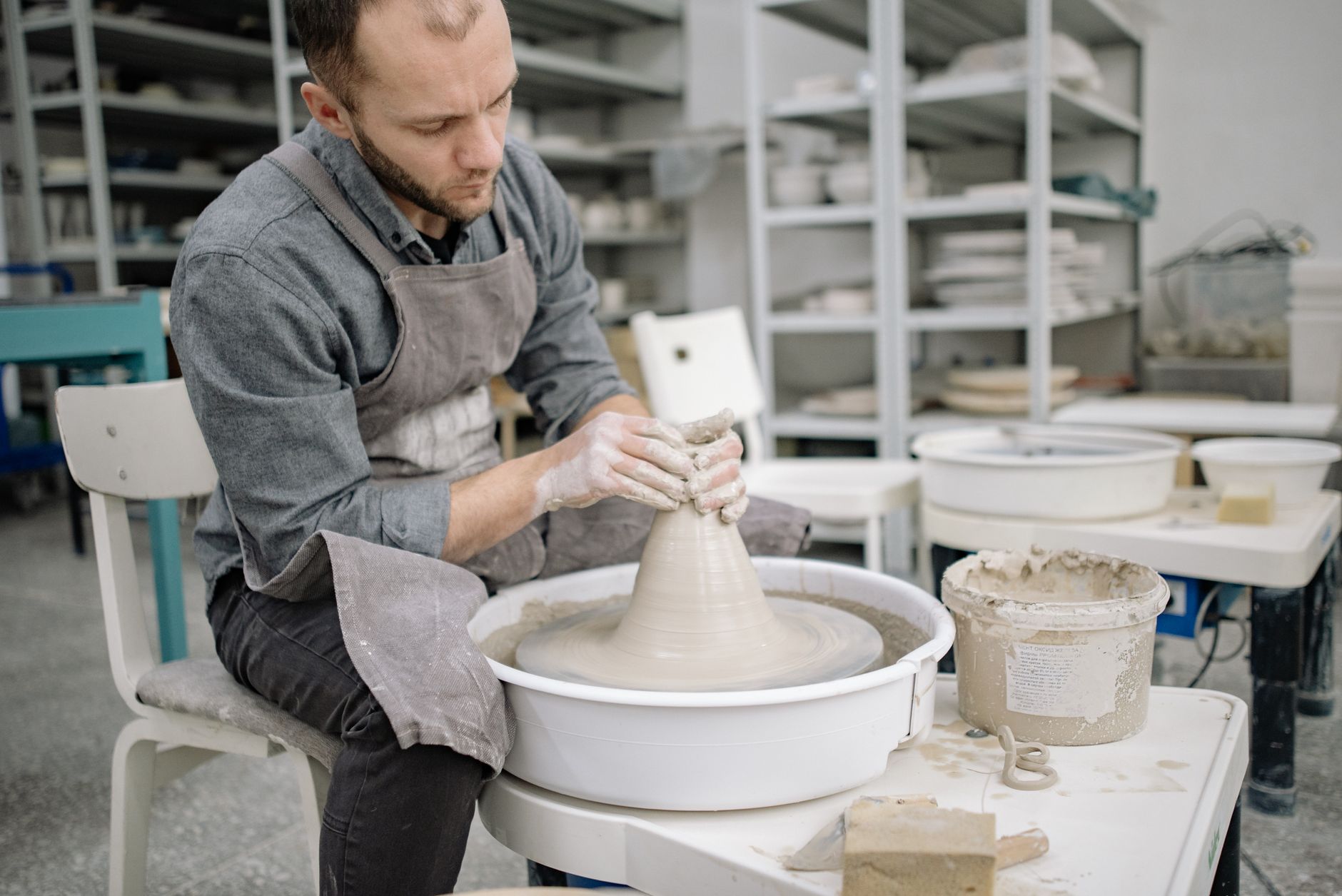
The wheel doesn't care about your age or your experience—it only responds to intention and touch. When you pull a loop tool across a rotating cylinder coated in dark black slip, exposing the warm, buff-colored stoneware beneath, you feel a direct line from your hand to the history of ceramic art itself.
The Crucial Rhythm of Timing and Consistency
If there is one secret to mastering sgraffito, it is learning to read the quiet language of drying clay. I learned this the hard way, decades ago, by rushing a piece before it was properly leather-hard. If your clay is too wet, the slip will smear, and your lines will drag rather than carve cleanly. If your pot has dried past the leather-hard stage into bone dry, the tool will chip the surface, sending sharp little shards flying and shattering the smooth curve of your line.
You want your vessel to feel cool to the touch, firm enough to handle without warping, yet damp enough to yield gracefully to the sharp edge of a carving tool. Paint your contrasting slip onto the leather-hard pot with confident, sweeping brushstrokes. Give it a few minutes to set up until the shine subsides to a matte finish. As you hold the piece, lightly press a fingernail into the base; if it leaves a faint mark without sticking to your skin, the canvas is ready for your hand.
Bringing Your Designs to Life Today
You can practice this technique in your home pottery studio this very afternoon, even if you are just beginning your ceramic journey. Throw a simple cylinder or pull a sturdy mug from the clay. Set it aside under plastic until it reaches that perfect leather-hard state. Brush on a generous coat of white engobe over your dark clay body—or vice versa, laying down a rich dark slip over a pale porcelain body.
Sketch your design lightly with a dull pencil or a wooden stylus, just enough to map out your composition. Then, take a sharp needle tool and let your instincts guide your hand. Carve fluid botanicals, rhythmic geometric patterns, or bold narrative illustrations. As you carve away the top layer, watch how the contrast pops into view. Finish your masterpiece with a clear glaze or a simple wipe-back technique before it makes its journey into the kiln.
Clay has a way of teaching you patience, presence, and the beauty of a steady hand. Every carved line tells a story of the moment it was made, preserving your unique touch in permanent stone.
If you are ready to dive deeper into the wonderful world of ceramics and expand your repertoire beyond the basics, I invite you to explore my complete video library. Get lifetime access to 8 detailed pottery video lessons covering wheel throwing, surface decoration, glazing, and more at jepsonpotteryvideos.com.
Watch Stephen Demonstrate This Technique
Get lifetime access to 8 detailed pottery video lessons — wheel throwing, hand-building, glazing, and more.
Get the Video Course — $49.99 with code I4N4LHE7OL →Learn Pottery from a Master
60+ years of wheel-throwing, hand-building, glazing, and kiln work — now in detailed video lessons you can follow at your own pace.
8 full-length videos · Lifetime access · $149 $49.99 with code I4N4LHE7OL
Photo by Yan Krukau • Published October 12, 2026
Learn with Stephen — the full course, $49.99 lifetime
8 full-length video lessons, one-time price, 30-day money-back guarantee.
Get the Video Course →